Science Park Ambassador Professor Claudia Köhler – »Plenty of Space, a Wealth of Expertise and a Very International Environment«
Flowering plants provide their embryos with their own food reserve. Prof. Claudia Köhler is analysing which genes control this nutrient tissue in the seed – and thus reproduction. Her findings could help to breed more resilient crops. She is involved as a location ambassador at Potsdam Science Park because fundamental knowledge and entrepreneurial spirit come together here in a “perfect way”.
The tissue structures that enable Arabidopsis thaliana, an unassuming cruciferous plant, to reproduce are clearly visible on the screen. The ovary, the placenta and the seeds attached to it – containing the embryos, surrounded by the nutritive tissue and the outer seed coat. Green, fluorescent dots in the nutritive tissue mark the activity of the genes.
“Using such markers, we can visualise different parts of the tissue and observe under the multiphoton microscope which genes are active at what stage in seed development,” says Claudia Köhler. Knowledge of gene activity in the endosperm and its epigenetic regulation provides key insights into the control of seed development, nutrient allocation and reproduction, and is crucial for food security, because much of our diet relies on the nutritive tissue that flowering plants supply to their embryos.
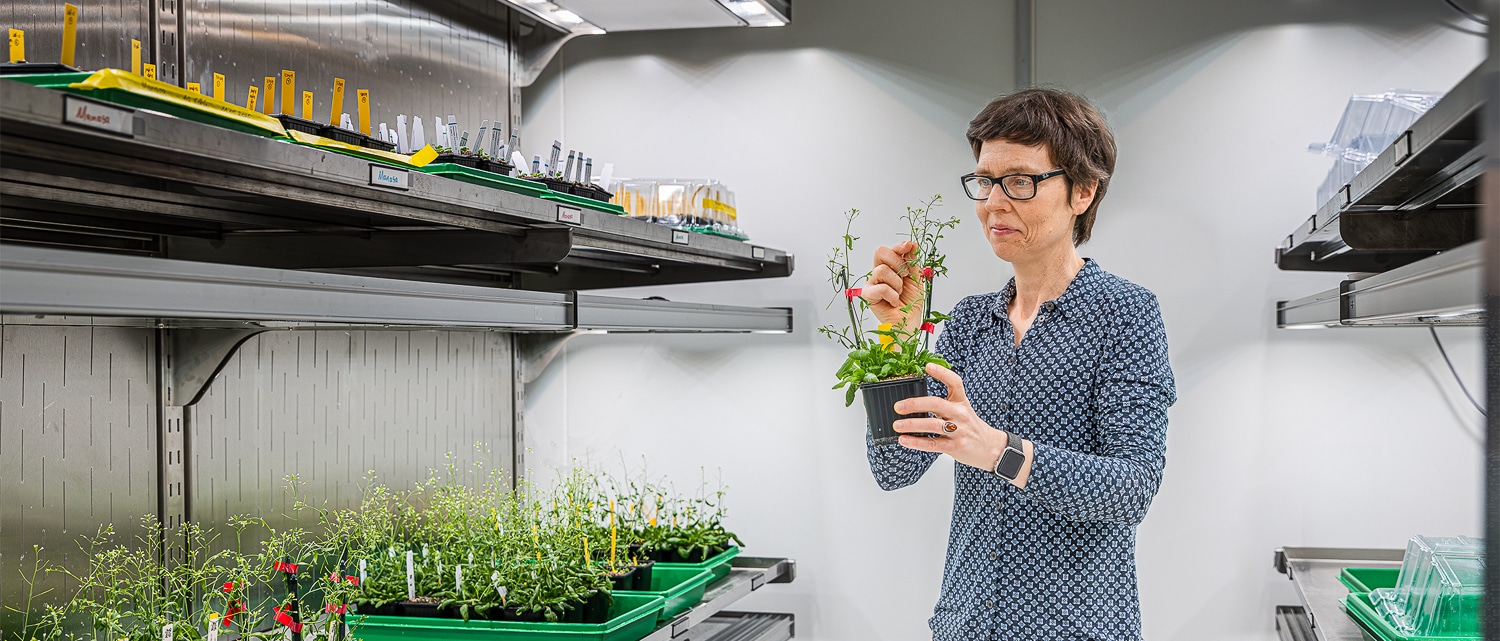
In her own garden – where she seeks a balance to her scientific work on plants – Claudia Köhler tends to pull up the thale cress, Arabidopsis thaliana, before it spreads too freely. Here in the laboratory, these delicate little plants are one of her most important model organisms for understanding seed development at the molecular level – alongside shepherd’s purse, water lilies, tomatoes, rice and maize. They all grow in the greenhouses of the Max Planck Institute for Molecular Plant Physiology at the Potsdam Science Park in Golm, where Köhler is Director and Head of the Department of ‘Epigenetic Mechanisms of Plant Reproductive Biology’.
Since June 2026, the Max Planck director has been acting as an ambassador for the Potsdam Science Park alongside her research, as she is convinced of its attractiveness. “There is plenty of space here, a wealth of expertise and a very international environment,” says Köhler, who, as a basic researcher, primarily seeks to collaborate with the University of Potsdam. “We attract the best people from around the world thanks to the excellent conditions, opportunities, and supportive environment we provide.” Students and researchers from over 70 nations are now represented at the Potsdam Science Park.
For Köhler, however, the Potsdam Science Park is also a model for the future, because strong basic research here forms the foundation for innovative capacity. “Site management also provides a central point of contact that ensures newcomers feel welcome and those interested in starting a business receive the necessary support,” she says. “All of this provides a very good foundation for further developing the site in the coming years.”
The Genetic Conflicts of Flowering Plants
In the laboratory, it is flowering plants that fascinate Claudia Köhler and her colleagues. One reason is that they have evolved a unique mode of reproduction known as ‘double fertilisation’. They use two sperm cells, one fertilises the egg cell and becomes the embryo, the other fuses with the central cell to form the nourishing endosperm. “This can lead to a conflict between the maternal and paternal genes,” says Köhler. “Whilst the paternal genes try to make their fertilised seed as large as possible to increase its chances of survival at the expense of the others, maternally inherited genes tend to counteract this. They help to distribute resources among all the seeds and limit the excessive growth of individual seeds.”
With their double fertilisation and the resulting genetic conflict, flowering plants have made an evolutionary leap. In conifers and other gymnosperms, whose seeds are not enclosed in a fruit, the maternal tissue nourishes the embryo and is formed even without fertilisation. This consumes unnecessary resources. “Flowering plants only utilise these resources once fertilisation has taken place,” says Köhler, for whom such questions of evolutionary biology are a major driving force. “Very few people are aware of how seeds are formed and what an important role the endosperm plays in them – the very part we eat every day when we consume rice or flour.”
Köhler is particularly interested in epigenetic processes because they control the function of the endosperm. For example, by observing which genes influence the ‘parental conflict’ and how gene activity is altered epigenetically (i.e. without changes to the DNA), one can begin to understand, amongst other things, why some seeds become smaller and others larger. “Understanding such relationships is of great interest to plant breeding,” says Köhler.
More Resilient Species for a Future in the Climate Crisis
New insights into epigenetic processes in the endosperm are particularly valuable at a time when humanity faces a climate crisis. This is because many high-yielding agricultural species are poorly adapted to drought or heat. New, climate-adapted varieties are therefore crucial for global food security. “If we succeed in overcoming the barriers to cross-breeding in the endosperm through epigenetic changes, it would be much easier to introduce traits such as drought resistance into high-yielding species,” says Köhler.
Until now, crossbreeding between related species has often been very labour-intensive. It requires removing the embryo from the seed and cultivating it in the laboratory; the chances of survival are low. Köhler’s team uses tools such as the CRISPR/Cas gene-editing system to modify gene activity in the endosperm and thus simplify crossbreeding between species. “With these new methods, it is possible to produce improved species very quickly – a crucial step towards climate-resilient agriculture.”
Vita Prof. Dr Claudia Köhler
A Perfect Environment for Basic Research
Claudia Köhler has a very close relationship with Arabidopsis. She was already conducting research on this cruciferous plant whilst a PhD student at the University of Freiburg. Later, she was able to elicit fundamental insights from the plant, including how genes responsible for the ‘parental conflict” are regulated in the endosperm. Köhler also discovered that mobile genomic elements, known as transposons, are crucial for the formation of that tissue.
The molecular biologist moved her research to Potsdam Science Park from Sweden in 2021, when she took up her position as director at the Max Planck Institute of Molecular Plant Physiology. Until 2024, she was also a professor at the Swedish University of Agricultural Sciences in Uppsala. Above all, it was the excellent conditions at the Max Planck Institute that convinced her to move to Potsdam-Golm. “I have secure funding here for my basic research and can study many other species alongside Arabidopsis,” she says. “The search for the most important genes and epigenetic factors is like a criminal case for me, where you’re trying to convict a perpetrator – you gather evidence, formulate hypotheses, and when the data all fits together in the end, it feels fantastic.”
Claudia Köhler hopes to solve many more exciting cases in plant (epi)genetics in Golm. “My grand vision is to fully understand which basic genetic modules make up the endosperm, how it develops after fertilisation, and what exactly determines its size,” she says. The technical methods to answer this question already exist – as do the curiosity and the right environment. “It’s a truly exciting time to be doing science,” says Köhler. “If we understand the fundamentals of plant genetics, it will be of great benefit to global food security.”
The projects carried out by Standortmanagement Golm GmbH at Potsdam Science Park are funded by the European Union and the Federal State of Brandenburg.
Text: Mirco Lomoth
Die Projekte der Standortmanagement Golm GmbH im Potsdam Science Park werden kofinanziert aus Mitteln der Europäischen Union und des Landes Brandenburg.
Text: Mirco Lomoth