Around 2.2 Million Euros to Open a New Window on the Universe
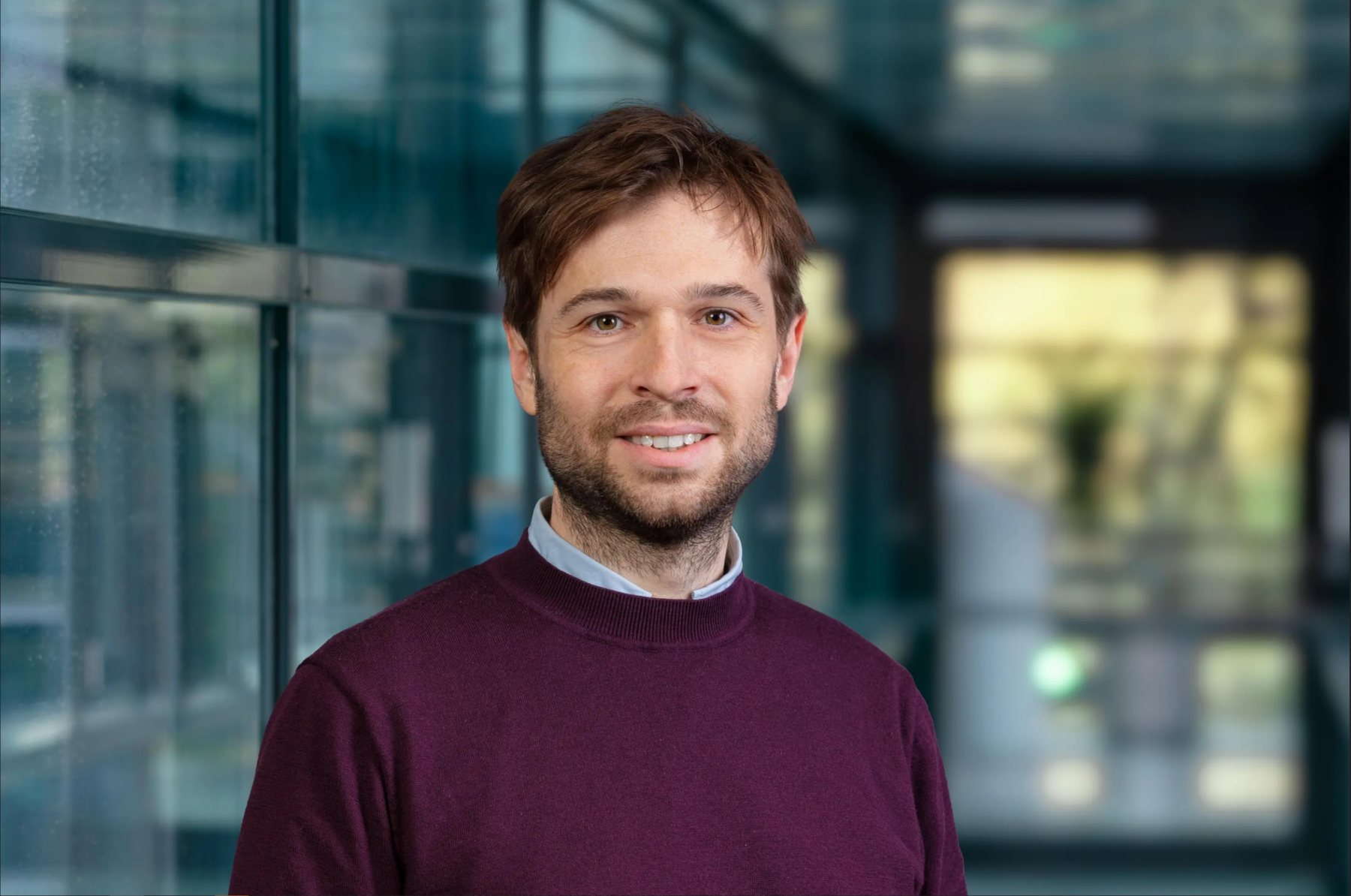
Max Planck Institute for Gravitational Physics (Albert Einstein Institute) | Miguel Zumalacárregui receives a Consolidator Grant from the European Research Council. The European Research Council selects a project on gravitational-wave lensing, led by Miguel Zumalacárregui, a group leader in the Astrophysical and Cosmological Relativity department at the Max Planck Institute for Gravitational Physics, with a budget of 2,185,000 euros over five years.
The Next Frontier: Lensing of Gravitational Waves
As gravitational waves travel through space, massive objects deflect, magnify and distort them. Lensed gravitational waves exhibit interference and diffraction patterns, creating a unique opportunity to study the Universe. You can find this video on YouTube. Click on the image to be redirected there.
You are currently viewing a placeholder content from YouTube. To access the actual content, click the button below. Please note that doing so will share data with third-party providers.
© M. Zumalacárregui, Max-Planck-Institut für Gravitationsphysik/Milde Marketing Science Communication
To the point:
- Gravitational-Wave Research Funded: The European Research Council selects a project on gravitational-wave lensing, led by Miguel Zumalacárregui, a group leader in the Astrophysical and Cosmological Relativity department at the Max Planck Institute for Gravitational Physics, with a budget of 2,185,000 euros over five years.
- Gravitational Lensing: Gravitational waves, like light, can be deflected by massive objects, creating a lensing effect that provides insights into astrophysical phenomena.
- The GLOW Project: Zumalacárregui’s project, “Gravitational Lensing of Waves” (GLOW), aims to develop theory and tools needed to analyze lensed gravitational waves and exploit their rich wave-optics signatures.
- Scientific Impact: The research will advance our understanding of dark matter, test the nature of gravity, and allow us to identify the most distant black hole mergers.
An object behind a glass of water appears distorted because both glass and water deflect light rays passing through it. Gravitation also causes such a “lensing effect”. Light traveling through the Universe is deflected by massive objects, sometimes creating multiple images of the same source. Einstein predicted this gravitational lensing effect, which has since become an important tool in astrophysics with many applications. For example, it is used in the search for extrasolar planets, in the interpretation of images of supermassive black holes, and in mapping the distribution of dark matter.
Gravitational waves
In 2015, the first gravitational wave, emitted by the merger of two black holes in the distant universe, was detected on Earth. The Max Planck Institute for Gravitational Physics contributed significantly to this achievement, which was honored with the 2017 Nobel Prize in Physics. Since then, gravitational-wave researchers have observed more than 200 events originating from the mergers of black holes and neutron stars. These signals reveal the final moments of compact binary systems and offer a new perspective on their population.
As these waves travel through space, massive objects deflect, magnify and distort them – a phenomenon known as gravitational lensing. Lensed gravitational waves exhibit interference and diffraction patterns, creating a unique opportunity to study the Universe. However, major theoretical advances are still needed to detect and interpret these subtle signatures.
GLOW – Gravitational Lensing of Waves
“Lensed gravitational waves are an exciting intersection of two predictions in Einstein’s theory. They carry information about the objects they encounter on their journey. Studying lensed gravitational waves will not only let us probe stars, their remnants, and dark matter, but also reveal the most distant black hole mergers and test the nature of gravity,” explains Miguel Zumalacárregui.
Through his ERC project, “Gravitational Lensing of Waves” (GLOW), Zumalacárregui aims to develop the theory and numerical tools necessary to model lensing by complex matter distributions. A major goal is to develop novel data-analysis techniques to discover and interpret lensed gravitational waves, including compact binaries that are too distant to observe with current detectors. “Signatures of lensing will allow us to probe and characterize small-scale dark-matter halos, which are otherwise very difficult to study,” says Zumalacárregui. “GLOW will also enable new tests of cosmological gravity and dark-energy theories. Finally, the same methods will be extended to other sources such as fast radio bursts.”
Upcoming upgrades to gravitational-wave detectors and radio observatories may allow these effects to be observed within the project’s lifetime, offering a unique opportunity to study the darkest objects in the Universe.
About Miguel Zumalacárregui
Miguel Zumalacárregui studied physics at the Autonomous University of Madrid and the University of Barcelona. He earned his PhD from the Autonomous University of Madrid in 2012 and held postdoctoral positions in Madrid, Heidelberg, Stockholm and Berkeley. Since 2020 Zumalacárregui is a group leader in the Astrophysical and Cosmological Relativity department at the Max Planck Institute for Gravitational Physics in the Potsdam Science Park.
Consolidator Grants
The European Research Council awards Consolidator Grants to excellent researchers to further strengthen and expand an independent research team. The ERC supports projects at European research institutions for five years.
In 2025, 3,121 applications for ERC Consolidator Grants were received, of which 349 are funded; the success rate for this tender was 11.2 %.
Original press release of the Max Planck Institute for Gravitational Physics